OpenLectura

SOCRATIC STEM & ENGLISH · K–2 THROUGH ADVANCED

Learn by working through the question.

51,544 blind-verified questions, 5,077 bite-sized lessons, and 1,582 reference chapters across 47 specialties. Answer first, then get feedback written for the idea behind the choice you made.

Free · No account · Web, iPhone & iPad · Keeps working offline after the first visit

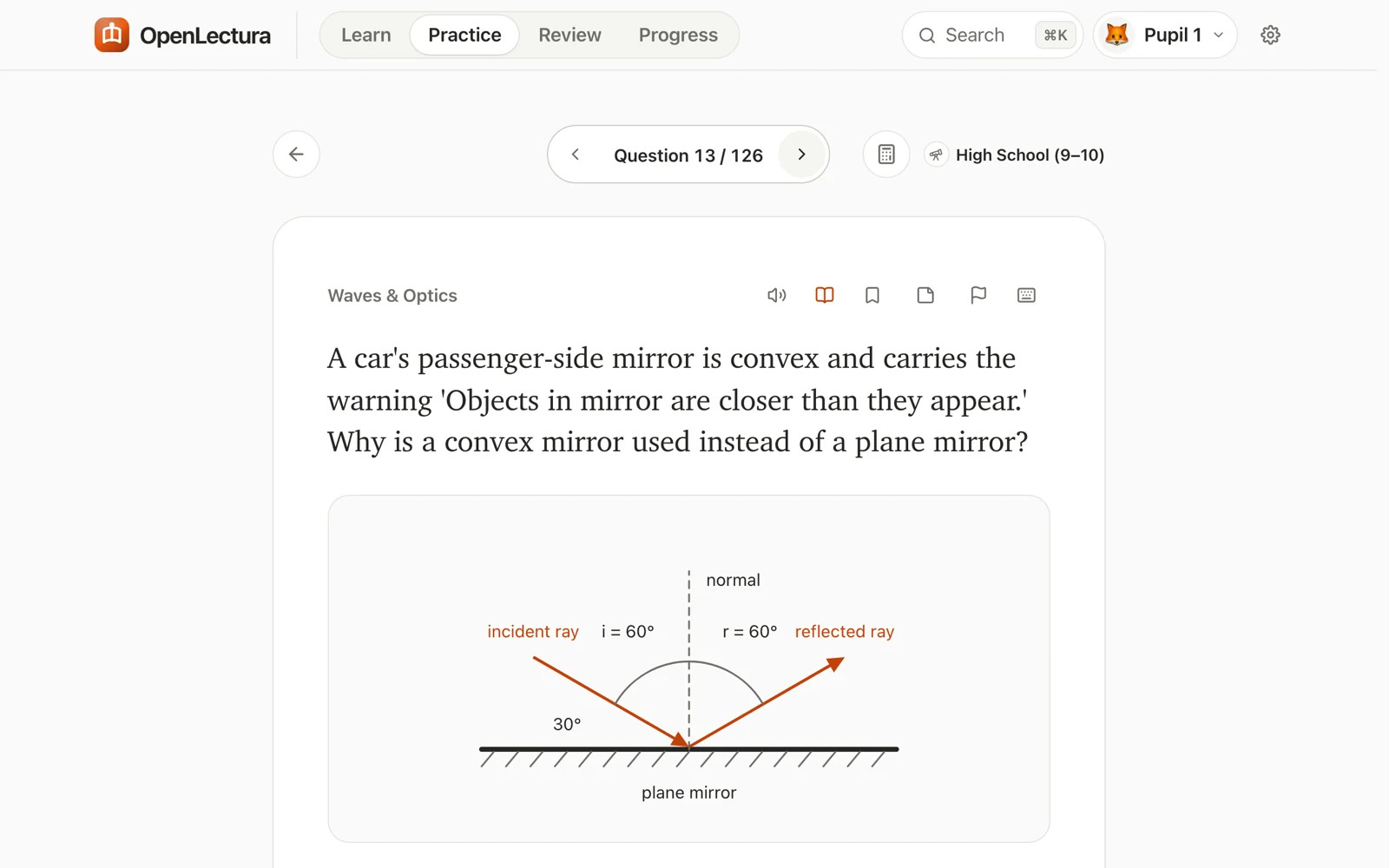
OpenLectura on the web showing a High School optics question with an incident and reflected ray diagram, calculator, and study controls
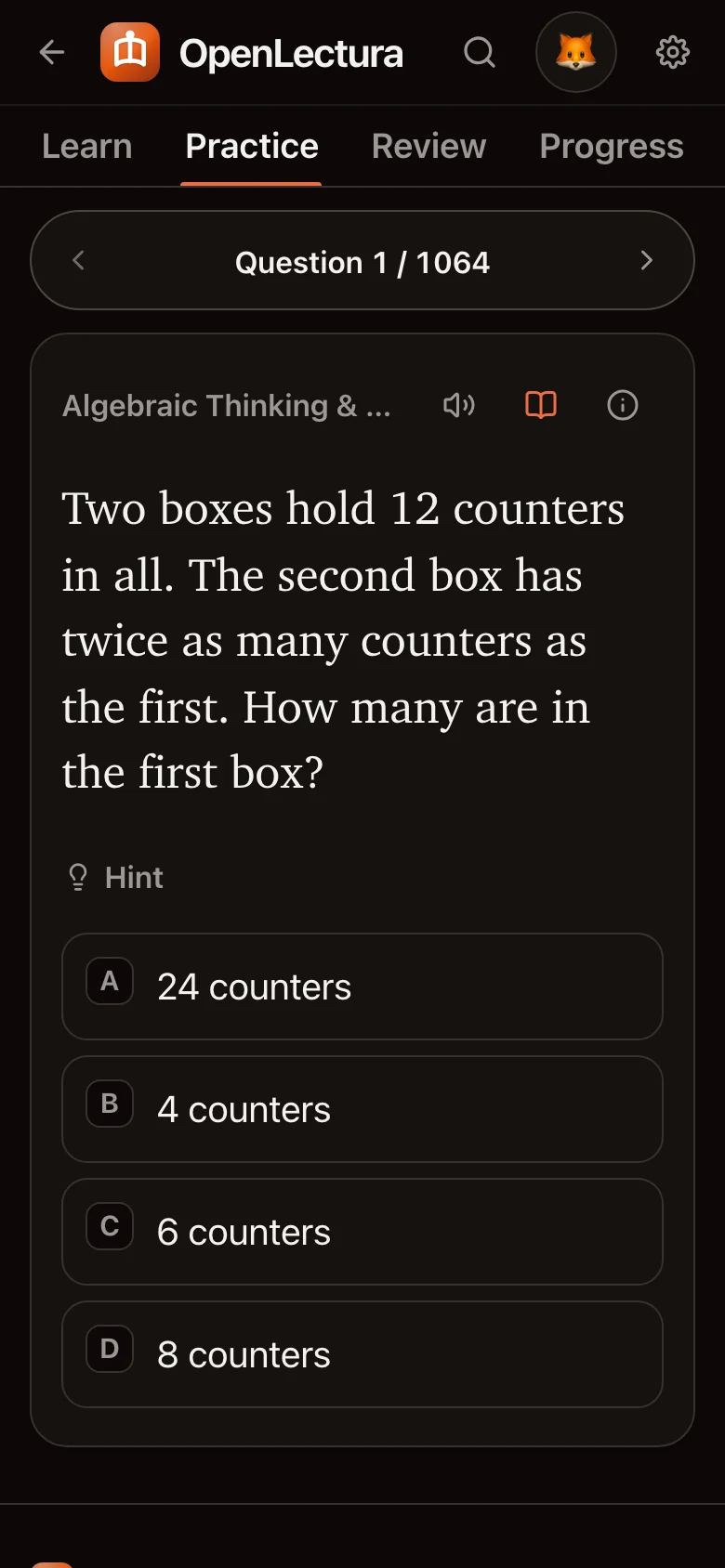
An algebra question in dark mode on iPhone
OpenLectura on the web and on iPhone in dark mode. Actual app captures from openlectura.audcath.com.
51,544blind-verified questions across 5 interactive formats
5,077bite-sized lessons & 1,582 reference chapters
47specialties across 6 STEM & English domains
0accounts, ads, or third-party trackers

01 · ANSWER FIRST

Make a prediction.
Then rethink it.

Every practice question asks you to commit before any explanation appears. A wrong answer is never a dead end: it names the misconception behind your choice, offers a Socratic nudge, and links straight to the matching lesson or foundation step.

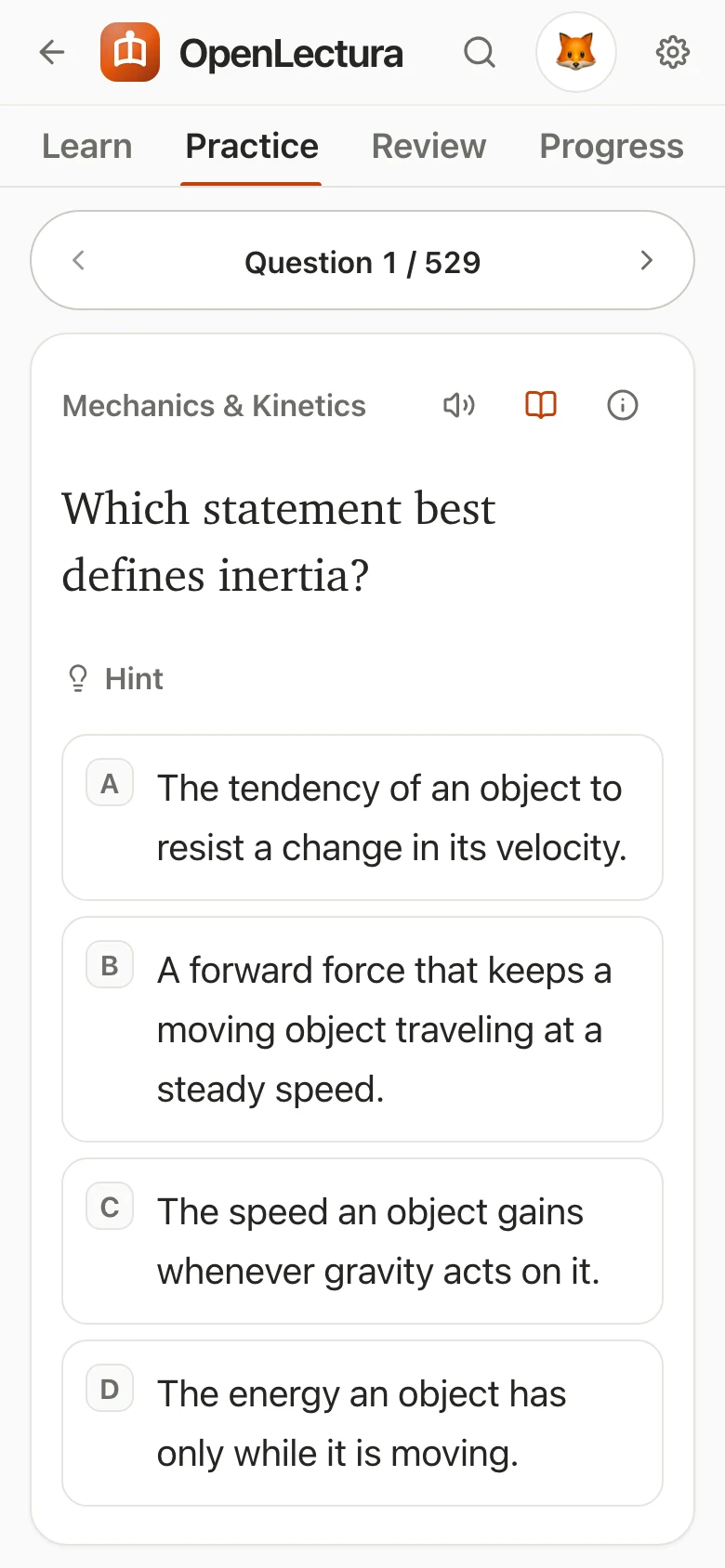
A Middle School Mechanics and Kinetics question about inertia on iPhone

Commit to an answer.

Concrete everyday language in K–5, full notation and derivations up through Advanced (12+), with progressive hints whenever you want them.

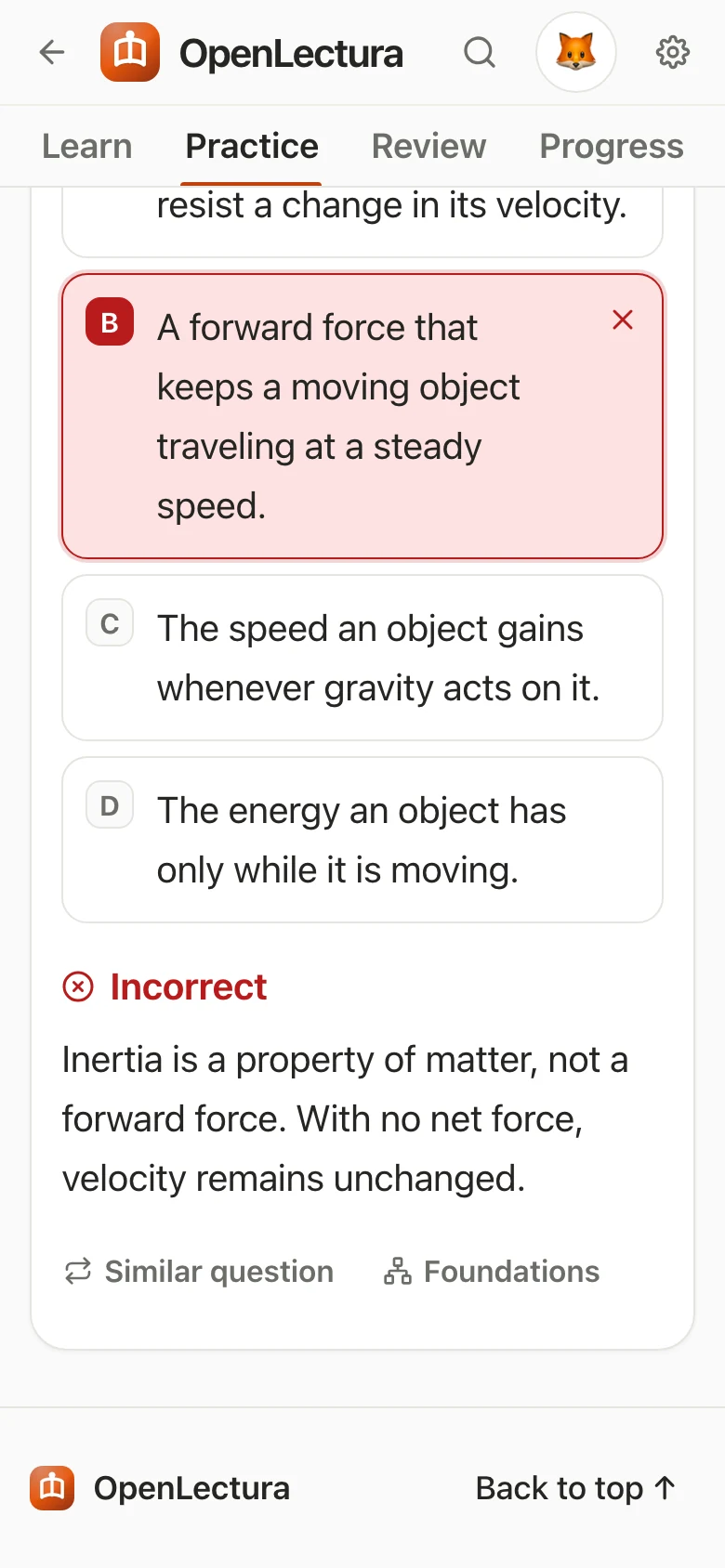
Socratic feedback on iPhone addressing the forward-force inertia misconception, with Similar question and Foundations links

Feedback for that idea.

Every wrong choice maps to a real learner misconception, paired with a similar-question drill and one-tap foundation stepping.

  • 47,445 itemsDiagnostic choiceFour balanced options where every distractor teaches through a specific misconception.
  • 2,385 itemsNumeric responseType calculated values, decimals, fractions, or scientific notation with unit tolerance.
  • 1,393 itemsMulti-select & orderingEvaluate multiple simultaneous claims (696) or sequence causal and proof steps (697).
  • 321 + 420Dictation & passagesSpoken spelling dictation (321) and close-reading literary & informational passages (420).
  • 12,594 visualsInline SVG diagramsCrisp, theme-aware physics rays, graphs, circuits, cells, and geometry drawn inline.

Foundations, one step down.

Stuck on a harder problem? Step into the prerequisite concept or open the linked bite-sized lesson, then come right back.

FSRS spaced review.

Adaptive spaced repetition schedules each concept right before it fades, while first-attempt scoring keeps mastery honest.

Built-in scratchpad & calculator.

Sketch steps on an inline canvas or evaluate expressions in a safe scientific calculator without leaving the question.

02 · LEARN LIBRARY

5,077 bite-sized lessons.
1,582 reference chapters.

Every specialty pairs concise, interactive lessons—complete with custom inline diagrams, worked examples, hands-on activities, and embedded checks—with deeper reference chapters placed strictly at their true reading level.
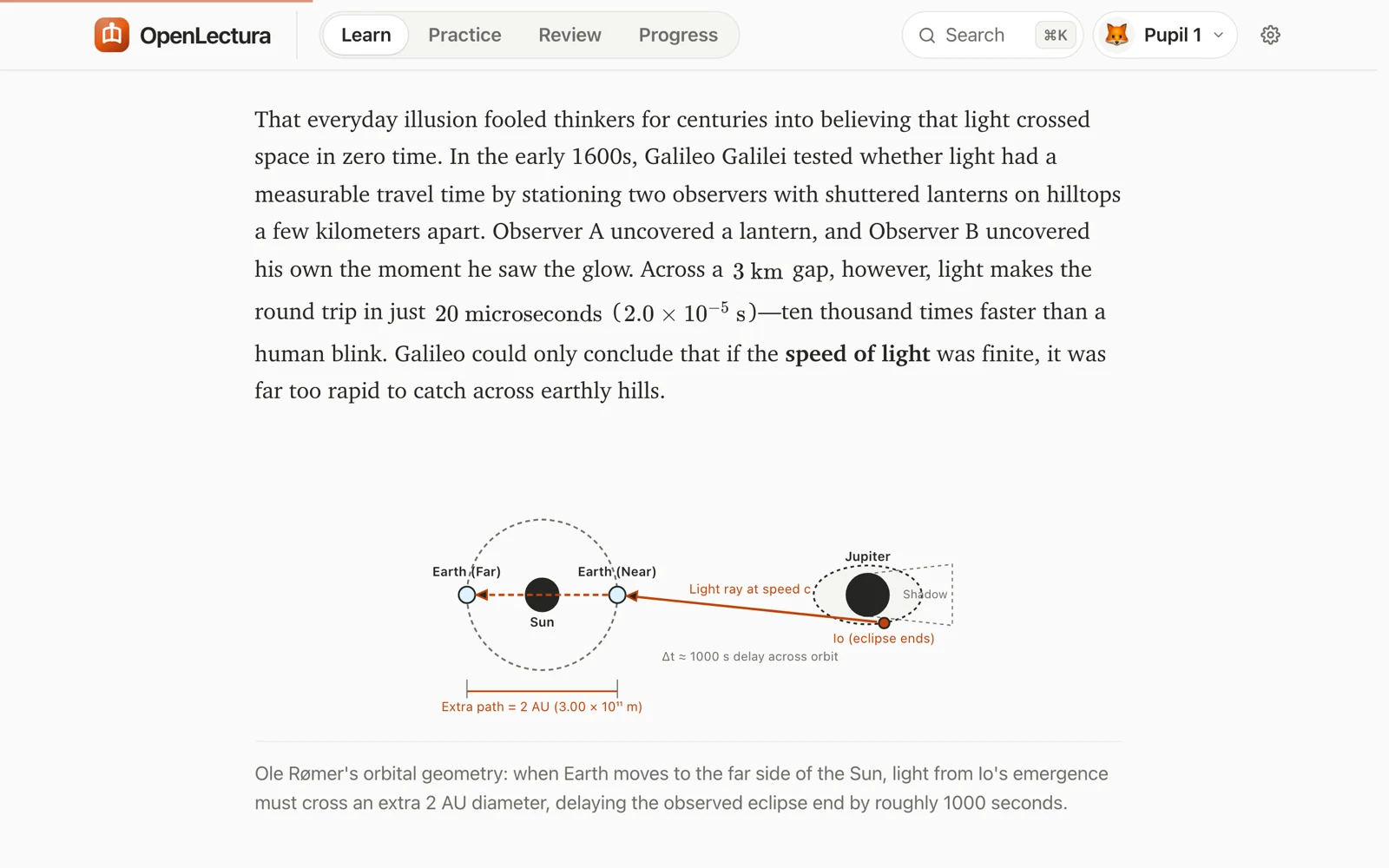
OpenLectura Modern Physics lesson on Ole Romer's measurement of the speed of light, showing an inline orbital geometry SVG diagram and KaTeX equations
Modern Physics & Special Relativity (Grades 9–10): interactive prose, custom theme-aware SVG geometry, worked examples, and inline checks.

True-level shelving.

Every lesson and reference chapter is calibrated to its real reading and math demand—upper subjects only appear when learners are ready.

1,931 glossary terms & read-aloud.

Tap defined vocabulary in context, adjust typography and reading comfort, or listen to full narrated lessons and chapters.

On-device semantic search.

Search 68,738 lesson, chapter, and question passages by meaning—powered locally in the browser with no external search servers.

03 · EVERY SUBJECT

Six domains.
Forty-seven specialties.

From Early Years counting and phonics to multivariable calculus, organic reaction mechanisms, and special relativity—all 47 specialties ship full native lessons, chapters, and blind-verified practice packs.
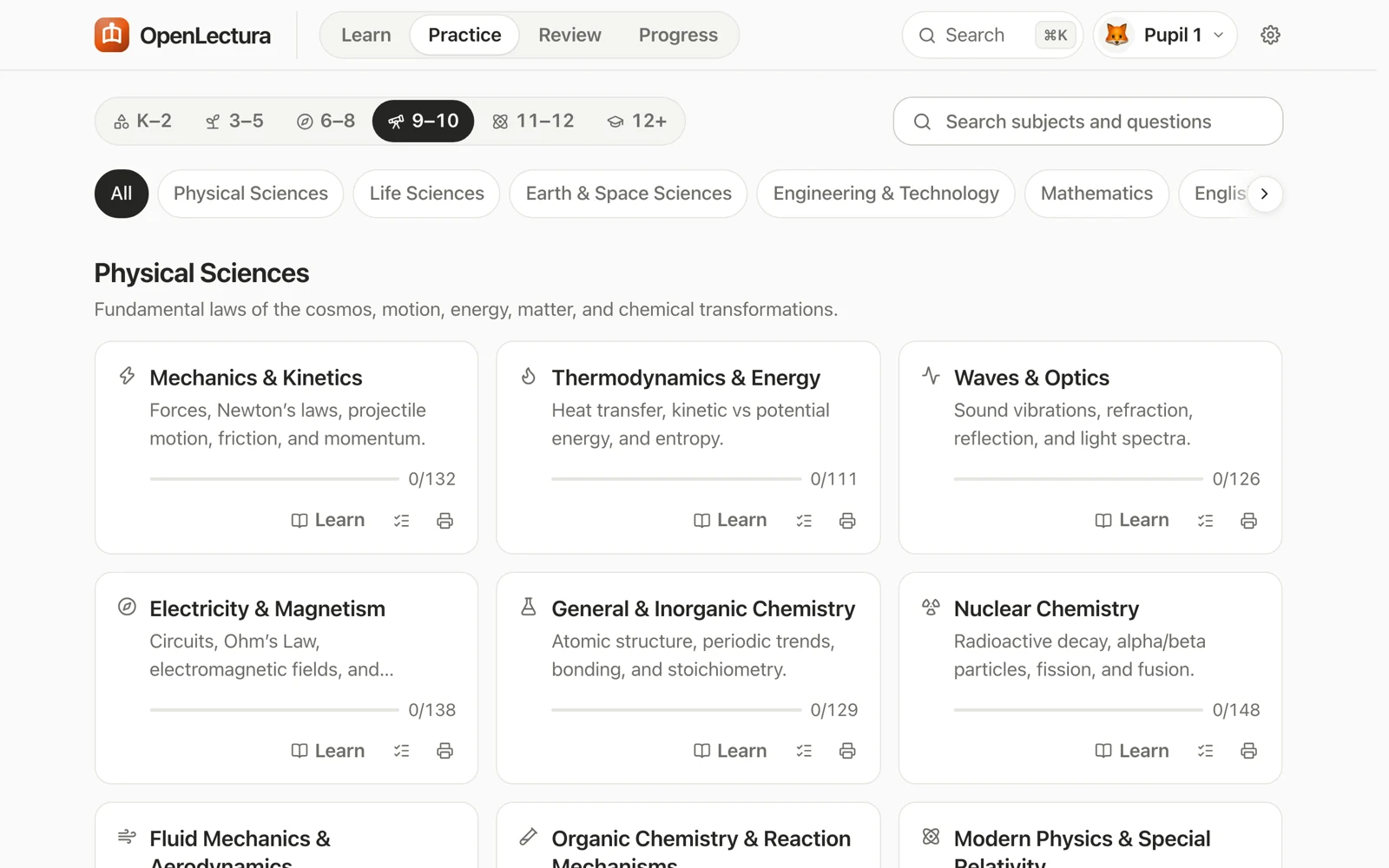
The OpenLectura practice catalog showing six level pills from K-2 to 12+, six discipline filters including English Language Arts, and expanded Physical Sciences specialties
  • Physical Sciences 9 specialties · 8,853 questions Mechanics & Kinetics, Thermodynamics & Energy, Waves & Optics, Electricity & Magnetism, Fluid Mechanics & Aerodynamics, General & Inorganic Chemistry, Organic Chemistry, Nuclear Chemistry, Modern Physics & Special Relativity
  • Life Sciences 9 specialties · 9,305 questions Cellular Biology, Genetics & Heredity, Microbiology & Immunology, Biochemistry & Metabolism, Neuroscience & Cognition, Evolutionary Biology, Ecology & Ecosystems, Human Anatomy & Physiology, Botany & Plant Biology
  • Mathematics 9 specialties · 12,859 questions Arithmetic & Number Theory, Algebraic Thinking & Algebra, Euclidean & Spatial Geometry, Discrete Math & Combinatorics, Probability & Statistics, Linear Algebra, Calculus & Analysis, Multivariable Calculus, Differential Equations
  • Earth & Space Sciences 7 specialties · 7,620 questions Astronomy & Cosmology, Planetary Science & Solar System Exploration, Geology & Solid Earth, Paleontology & Earth History, Meteorology & Climatology, Oceanography & Marine Science, Climate Dynamics & Renewable Energy
  • Engineering & Technology 6 specialties · 6,799 questions Engineering Design & Optimization, Computer Science & Logic, Digital Electronics & Computer Architecture, AI, Machine Learning & Data Science, Materials Science & Statics, Robotics & Feedback Control
  • English Language Arts 7 specialties · 6,108 questions Grammar & Usage, Punctuation & Capitalization, Phonics, Spelling & Word Study, Vocabulary & Word Meaning, Reading Literature, Reading Informational & Argument Texts, Writing, Style & Rhetoric
  • Early Years · Grades K–23,998 questions & 617 read-aloud lessons. Concrete everyday ideas, zero symbolic algebra.
  • Elementary · Grades 3–56,691 questions, 827 lessons & 201 chapters. Clear foundational reasoning with concrete models.
  • Middle School · Grades 6–816,347 questions, 974 lessons & 394 chapters. Systems, proportional formulas, and first mechanisms.
  • High School · Grades 9–106,161 questions, 827 lessons & 336 chapters. Formal quantitative modeling, proofs, and GCSE/Honors depth.
  • High School · Grades 11–127,624 questions, 862 lessons & 349 chapters. Multi-step AP, IB Diploma, and A-Level rigor.
  • Advanced · 12+10,723 questions, 970 lessons & 302 chapters. University foundations, Further Maths, and Olympiad stretch.

Developmentally staged: specialized upper subjects (such as Nuclear Chemistry, Organic Chemistry, Linear Algebra, and Biochemistry at 6–8+, and Modern Physics, Multivariable Calculus, and Differential Equations at 9–10+) appear only on shelves where learners are ready for them.

04 · FOR CLASSROOMS

Assign or print in a minute.
No sign-ups.

Build a custom quiz by specialty and level, share it as a QR code, collect signed offline turn-in receipts as CSV, or print clean student worksheets with shuffled options and a matching teacher answer key.
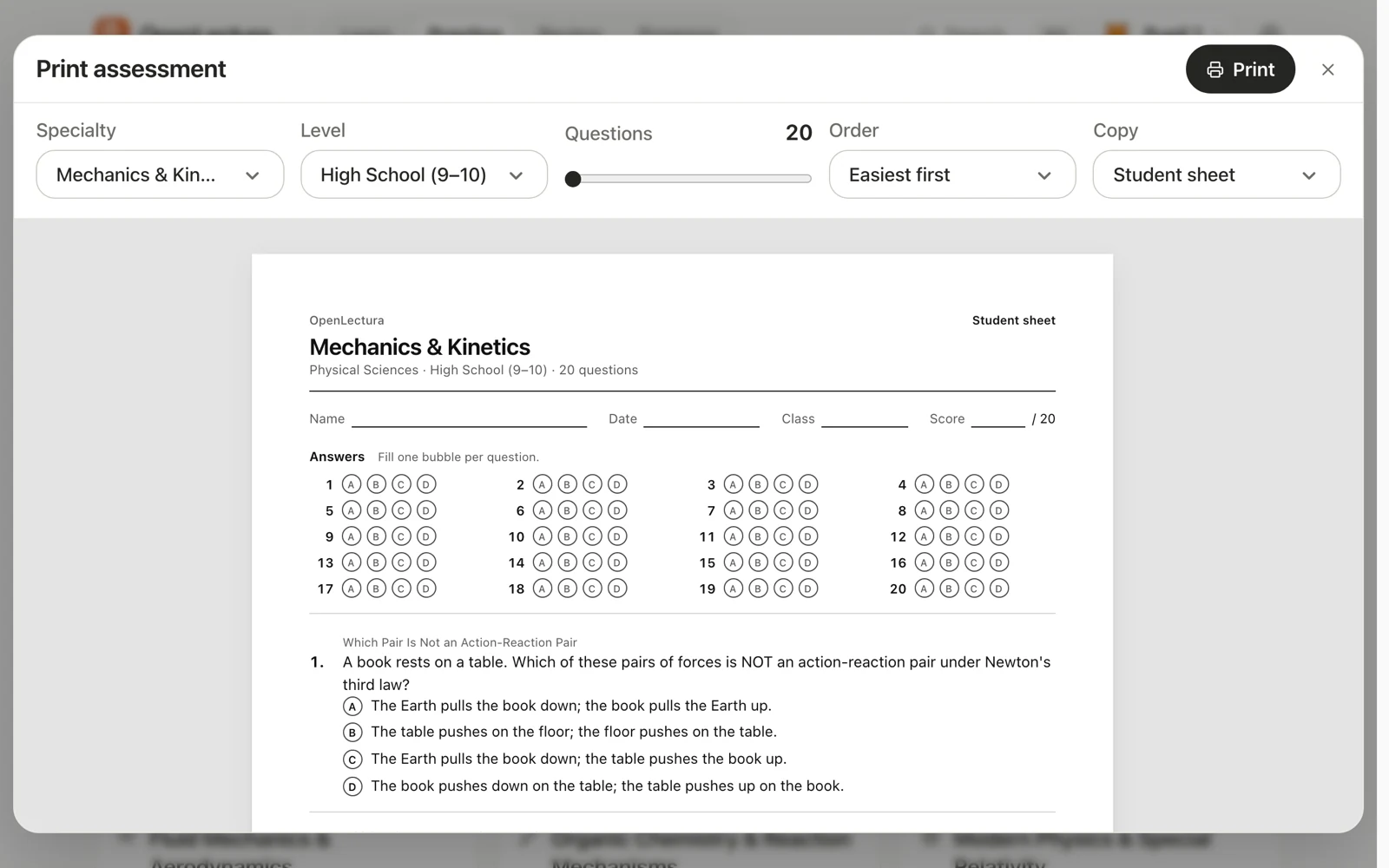
OpenLectura Print Assessment modal showing a 20-question High School Mechanics student sheet with a bubble answer grid and teacher key switcher

Share & scan by QR.

Launch the same question set across a classroom via QR code, and scan student turn-in codes straight from the browser camera.

Print when screens are scarce.

Student sheets with bubble grids and matched teacher keys print cleanly, with every equation and SVG diagram intact.

Export receipts & backups.

Learner mastery summaries, common misconceptions, and CSV turn-in rosters stay on your device until you choose to export them.

ON YOUR DEVICE

Built to stay out of the way.

OpenLectura runs in the browser or installs like a native app with nothing to sign up for. Progress stays on your device, and the entire curriculum works offline.
  • Nothing to hand over.No account, no advertising, and no third-party analytics layer between a learner and the work.
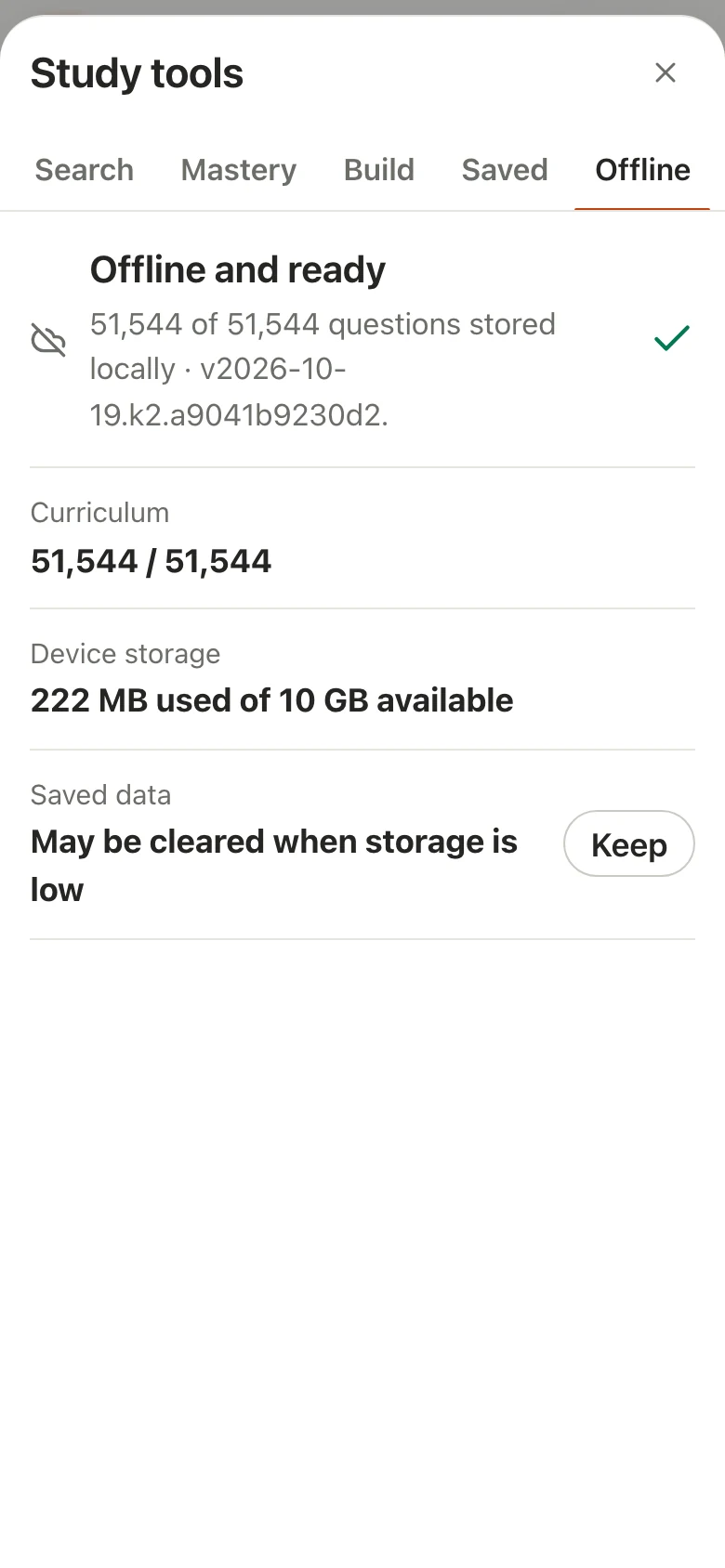
  • All 51,544 questions offline.After the first visit, every practice pack, 5,077 lessons, 1,582 reference chapters, and on-device semantic search work without a signal.
  • Made for shared devices.Separate local pupil profiles, plus checksum-protected checkpoint codes and QR snapshots to resume on another device.
OpenLectura Study tools on iPhone showing Offline and ready with all 51,544 of 51,544 questions stored locally
Captured with the network switched off.

A LITTLE MORE TO KNOW

Questions worth asking.

What is Socratic STEM & English learning?

OpenLectura starts with a question. Making a prediction gives the feedback something specific to work with, so every response can address the exact misconception behind your choice—and connect you directly to the bite-sized lesson or prerequisite concept you need next.

How many questions, lessons, chapters, and specialties are included?

51,544 independently blind-verified practice questions, 5,077 bite-sized interactive lessons, 1,582 reference textbook chapters, and 1,931 glossary terms across 47 specialties in six domains: Physical Sciences (9), Life Sciences (9), Mathematics (9), Earth & Space Sciences (7), Engineering & Technology (6), and English Language Arts (7).

What grade levels and question types are supported?

Six levels from Early Years (K–2) and Elementary (3–5) through Middle School (6–8), High School (9–10 and 11–12), and Advanced (12+ / AP / IB / Olympiad). Questions include diagnostic multiple choice (47,445), numeric free-response (2,385), multi-select (696), step ordering (697), and audio dictation (321), alongside 12,594 inline SVG diagrams and 420 close-reading passages.

Do I need to make an account?

No. OpenLectura runs in the browser without a sign-in and keeps its study records strictly on the device you use.

Can more than one person use a shared device?

Yes. Each learner can keep a separate local pupil profile, and compact checkpoint codes or QR pupil snapshots let them pick up where they left off on another device.

Does OpenLectura work without internet?

Yes. The first visit caches the app and stores the complete 51,544-question library, 5,077 lessons, 1,582 chapters, and on-device semantic search locally. Practice, review, reading, and classroom print tools all keep working offline, and it can be installed as a PWA on desktop, iPad, or iPhone.

How can teachers use it with a class?

Build quizzes or assignments by specialty and level, share them by QR code, print paper student sheets with bubble grids and teacher keys, scan signed offline turn-in receipts, and export CSV summaries—all without cloud accounts or student data collection.

Where is learner data stored?

Only in the browser on the device being used. Nothing is sent to a server unless someone exports a backup, receipt CSV, or QR snapshot and chooses to share it.

A LITTLE MORE TO EXPLORE

A question.
A place to begin.

Open the web app, pick any of 47 specialties, and make your first prediction.

Open OpenLectura